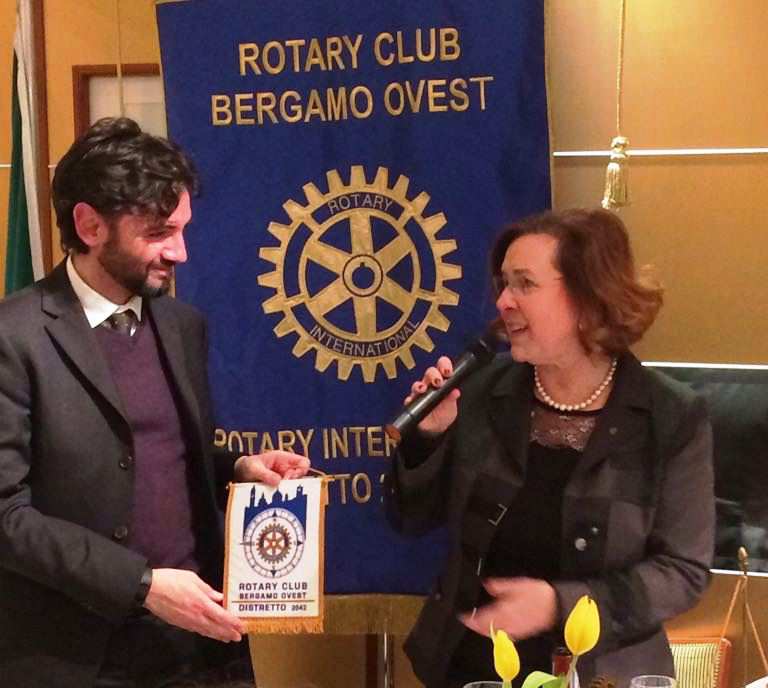
On Monday, December 4, 2017 – During the sixteenth Rotary convivial held at the Rotary Club of Bergamo headquarters, three scholarships were awarded in memory of Mario Caffi, a distinguished Bergamo business lawyer, professor of bankruptcy law at the University of Bergamo, and Rotary Club member.
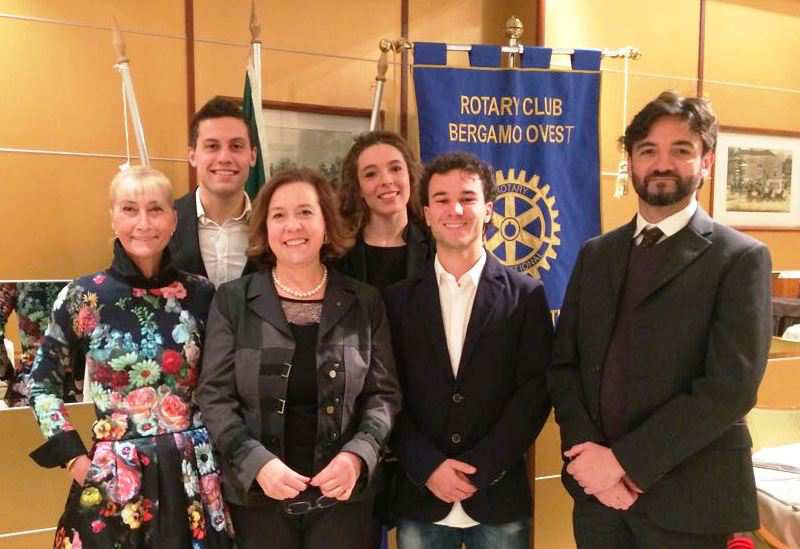
The ceremony was attended by the three winners—Francesca Cesarini, Roberto Radaelli, and Fabio Rota—and Professor Roberto Pinto, a lecturer at the University of Engineering in Dalmine, who presented Bergamo 2.035, the research project in which the three students will participate.
Bergamo 2.035 | REAL Cities – Smarter Citizens is a multi-year, interdisciplinary research program promoted by the University of Bergamo and Fondazione Pesenti, with the scientific collaboration of Harvard University and the partnership of the Municipality of Bergamo.
The research originates from a shared desire to analyze the main trends and scenarios that characterize the Smart City model in urban and rural territories over the coming decades, with the aim of identifying possible solutions to be tested in the Bergamo area. The project focuses on future citizens, the “smarter citizens” who become active agents of change for the improvement of the urban environment.
This year, the theme addressed is Digital / Physical Retail. The research will explore the challenges related to integrating digital technologies and physical spaces in the retail world, investigating both opportunities and impacts in urban, commercial, and domestic contexts, as well as the user experience in both real, tangible settings and virtual environments. Through a comparative analysis of retail between the United States and Europe—including a systematic review of scientific literature case studies, and field investigations—the research aims to analyze the history of retail, understand current dynamics, and—with particular focus on the cities of Boston and Bergamo—propose innovative solutions on five different scales:
The retail store shopping experience
Shops and shop windows
“Smart” home environments
Medium-sized shopping centers
Mobile and hybrid platforms
Main topics of the course
– DESIGN RESEARCH: An overview of the interaction between design and research: designing to structure innovative research methods and research to give life to innovative design approaches. Examples and cases from Harvard GSD complement the theoretical approach.
– DESIGN THINKING: Study of design thinking methodologies through the application of new approaches to solving problems in any field and at different scales. Sometimes, solving a problem requires an innovative and interdisciplinary mindset that goes beyond conventions. Combining subjective analysis with objective data, reconsidering business or design challenges by approaching them from an unusual perspective.
– HUMAN-CENTERED DESIGN ED ESPERIENZA UTENTE: Principles of human-centered design, with special attention to strategies for evaluating and anticipating user experience from the perspective of different types of individuals. Strategies include: user experience scenarios, personal studies, user journey design, simulations, and models.
– RESPONSIVE TECHNOLOGIES: Opportunities and impacts of integrating new media, sensors, and interactive technologies in cities, addressing issues of technological longevity, dynamic adaptation, and augmented realities.
At the conclusion of the convivial, Francesca Rigamonti Caffi recalled the commitment and enthusiasm that always characterized Mario Caffi, in whose memory the scholarship is named, emphasizing his forward-looking spirit—both in anticipating developments and evolutions and especially in his dedication to preparing young generations for new challenges.
Comunicato Stampa