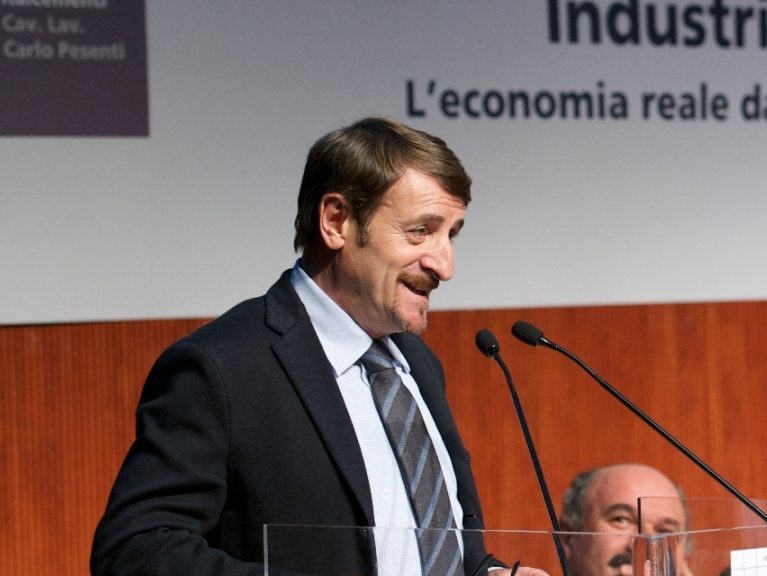
Restarting from the real economy to find the path to growth and allow Italy and Europe to maintain the social achievements and well-being gained through industrial development in the twentieth century.
Bergamo, January 21, 2012 –
Industry: An Undertaking. The Real Economy from the Present to the Near Future. Restarting from the real economy to find the path to growth and enable Italy and Europe to preserve the social conquests and well-being achieved thanks to industrial development in the twentieth century.
This was the message of the annual conference of the Fondazione Cav. Lav. Carlo Pesenti, which brought together in Bergamo representatives from business, trade unions, and culture.
Among those present were, among others, Emma Marcegaglia, President of Confindustria, and Susanna Camusso, Confederation Secretary of the CGIL. The roundtable was moderated by writer and columnist Gianni Riotta. As explained at the opening by Giovanni Giavazzi, President of the Fondazione Cav Lav. Carlo Pesenti, the goal of the meeting was to seek those:
“elements capable of uniting the common effort of which we feel the daily increasing need.”
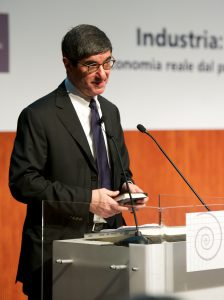 Gianni Riotta, introducing the roundtable guests, focused on two “key words” in the conference title: real and future.
“In a period like the present, there is much discussion about the economy, crisis, and economic development in Italy and the world, but often the real is overlooked. People talk about intentions, how we ‘would like’ growth, industry, and our country to be, but they do not look at reality as it is today.
Italians and Europeans refuse to see reality as it is and look to the future with difficulty.” Riotta concluded his introduction with a positive message about Italian companies that fortunately “still prosper in large numbers today,” and “have been able to look at reality while also turning their gaze to the future with optimism.”

Raghuram Rajan
“Even though this is probably the most critical moment in the history of capitalism, we must hope that trust prevails, that adjustments happen without too much anger against the system.” This was the message of economist Raghuram Rajan, advisor to the Indian Prime Minister and former IMF economist, who contributed via video to the Foundation’s conference.
“This,” Rajan continued, “does not mean the system works perfectly: we need to define public intervention methods, increase workforce training, and improve the stability of the financial system.”
In his intervention, the economist also addressed the rise of China and India as global economic powers, often seen by public opinion as threats, whereas Rajan believes “there is room for a win-win situation. Certainly,” he said, “on average the products sold in emerging countries are not the same that work in wealthier situations. Companies from industrialized countries must position themselves in these growing markets to understand the context and real needs.”

The Bishop of Bergamo
Bishop of Bergamo, Monsignor Francesco Beschi, spoke about the need to create a “new development model that allows a return to reality.”
“To do what we can, work industriously, help each other, and then be content,” as the tailor in The Betrothed recounted the words of Cardinal Federigo. Because being alive means you can always handle the material, appreciate the substance of reality.
“Benedict XVI, speaking to the German Parliament, recalled that matter is not only a support for our actions but has intrinsic dignity.
Genesis says it is good, the expression ‘material good’ means we have done a ‘good.’ Substance has to do with human good.”
The Bishop also criticized “financial deformations,” phenomena where “what lacks real substance is perceived and represented as more real than the real.
Anonymous capital enslaving humans is a destructive power that threatens the world.”
Without a clear understanding of things, reality slips away, leaving space for hyper-real distortions: “the weight of virtuality, religious and financial deformations, until reality becomes a bursting bubble.”
For Monsignor Beschi, it is therefore important to have “a contemplative gaze, not an alternative to practical needs. It is necessary to have a gaze that is not rapacious, attracted only by profit and utility, but a comprehensive gaze that recovers the value and meaning of things.”
In conclusion, the Bishop said that man alone is not enough; rather, a demanding relationship among all humans is necessary.
“I am ready to discuss what I am saying; we all feel a kind of deficit of strength under our efforts, which need to be supported by the resource called Spirit in humans.
We live as if on a stage, with the world and history as backdrops, even religion as scenery. But scenarios are insufficient; a vision is necessary.”
Roundtable
From the roundtable interventions, some suggestions emerged, including: reducing excessive bureaucracy, increasing productivity by lowering the cost of production factors such as services, introducing more competition and flexibility, and focusing on young people’s ideas.
“Claiming that competitiveness can be based only on labor costs and low wages,” said Giorgio Barba Navaretti, Professor of Economics at the University of Milan, “is the wrong approach. We must overcome the dualism of the labor market and favor the transfer of human resources from less productive companies to more productive ones, which do exist.”
Efficiency and equity were key concepts in Carlo dell’Aringa’s intervention, professor at the Catholic University of Milan:
“Man creates changes and then fails to manage them, including global competition. Welfare and work are the essence of the European model. Efficiency and equity are a difficult balance,” the professor continued.
“The challenge is how to maintain it during the crisis. Perhaps with greater unity of purpose to achieve the result, fixing the entire context before touching labor. Sacrifices are inevitable but can be directed to provide opportunities for the next generation.”
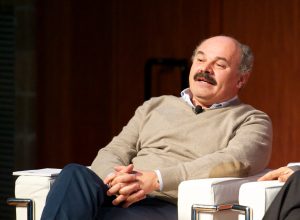
Another crucial theme was bureaucracy reduction.
“I deal with agrifood,” said entrepreneur Oscar Farinetti, founder of “Eataly,” the first format worldwide dedicated entirely to high-quality food (supermarket and restaurants).
A sector in Italy that expresses less than 20% of its potential, precisely because of so much bureaucracy. With a couple of moves in two or three years, we could triple exports.”
The entrepreneur tried to convey optimism and hope that energy and renewal capacity, along with reducing bureaucracy, can help overcome moments of crisis and difficulty.
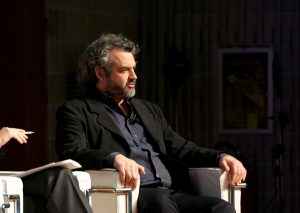
Finally, youth. “There is great potential for enterprise.” This was the view of writer Edoardo Nesi, winner of the 2011 Strega Prize with the novel Storia della mia gente (Story of My People).
The book, partly autobiographical, describes how the “tsunami” of Chinese presence is overwhelming the paradigms of the textile industrial district of Prato and small provincial Italian industry.
Nesi himself had to sell the family textile company before it was “swept away.”
“But we need to change almost everything. We need to invest in forgotten people, who are the youth. When I was young, there was a widespread belief among us that it would all end well; young people had confidence in the future. That is what we must recover. We need to focus on young people’s ideas and support the creation of new enterprises.”
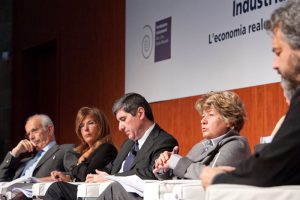 Cautious about liberalizations was CGIL secretary Susanna Camusso:
“Liberalizing recklessly will bring us trouble,” speaking particularly about shop opening hours and noting, “whereas now everyone is enthusiastic because everything is being liberalized.”
She expressed appreciation for the government addressing inequality:
“We face an extraordinary capitalist crisis caused by excessive greed. For some years inequalities have started growing again in our country.
It is a surreal and hard-to-digest vision to think that the brake on growth is found in Article 18. What I appreciate about the government is that it has begun to speak about inequality, addressing legality and tax evasion.”
She expressed reservations about privatizations:
“Big players in Italy are mostly publicly owned. I hope they remain so, and I hope there will be no iconoclastic privatization frenzy. When they say reduce the presence of the state,” Camusso concluded, “there are things that can be done, but are we sure everything is simplifiable and that this doesn’t mean reducing attention and care for people?”
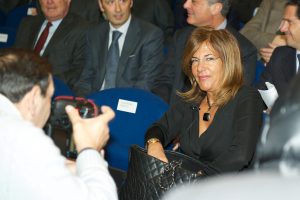 Convinced supporter of privatizations, Confindustria president Emma Marcegaglia said:
“Liberalizations are essential. It is a fundamental issue that has finally been advanced. There will be outcries: let them shout; what matters is that the government moves forward on this path.”
On the subject of labor, ahead of the upcoming negotiations between social parties, Marcegaglia stated:
“In serious companies, our greatest strength is our workers; there is no doubt about that. We do not want to fire our workers. We will approach this negotiation with great responsibility.
There is only one thing we want to do,” Marcegaglia explained, “we want to be able to manage restructuring: if a product no longer works, we want to close a production line and open a new one. That is the only thing we want. We don’t want to fire our workers, but only to avoid situations where people do not work—and on this a ‘modern’ union can only agree.”
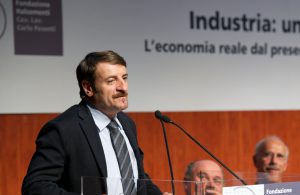
A particular perspective was offered by actor Giacomo Poretti, who, with light tones, told with a disenchanted gaze the life experience in Lombard industry and its changes.
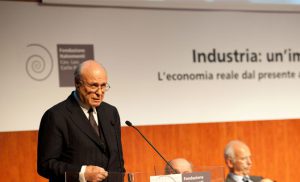
To close the conference, President Giampiero Pesenti said:
“From today’s discussion, three crucial elements clearly emerged that we need to focus on: the need for profound changes regarding the efficiency of government interventions; the importance of adequate training for individuals ; the stability of the financial system. These are indispensable interventions for a great change that can preserve the well-being we have achieved.”
“The attention and interest with which the conference was followed,” Pesenti concluded, “testify once again to the shared perception of how necessary dialogue and responsibility are, involving the business world, unions, academia, and civil society, especially with the goal of opening positive prospects for future generations.”
Invito
Comunicato stampa
Programma del Convegno e CV dei Relatori
Discorso integrale G. Pesenti
Discorso integrale G. Giavazzi
Discorso integrale R. Rajan
Discorso integrale G. B. Navaretti
Discorso integrale G.Poretti
Rassegna Stampa
Welcome and Opening Speeches
Speakers
Monologue
Gallery
[oqeygallery id=”7″]