Positive results for the startup awarded by Fondazione Pesenti during the first edition of the SHaReD call.
The first smart active seismic response control system, applied to a reinforced concrete structure, successfully resisted simulated earthquakes with a magnitude of 6.9 on the Richter scale, comparable to the 1980 Irpinia earthquake.
March 2021 – The ISAAC Earthquake experimental campaign concluded successfully. During the campaign, two reinforced concrete structures (over 8 meters high) with brick infill, one equipped with I-Pro 1 and the other without, were subjected to “artificial earthquakes” at the EUCENTRE research center, to compare the seismic effect of increasing intensity and the damage on both structures.
For a correct evaluation of results, the two models were designed, built, and constrained at the seismic base identically and subjected to the same sequence of “shocks”; the campaign lasted 3 days (March 8-10, 2021).
The building equipped with I‑Pro 1 resisted consecutive earthquakes up to the maximum intensity, with a peak ground acceleration of 0.44g, equal to 137% of the energy of the 1980 Irpinia earthquake (magnitude 6.9 on the Richter scale).
The ISAAC Earthquake experimental campaign is unique in the civil engineering sector, both nationally and internationally: it is indeed the first experimental test of an active seismic response control system installed on a full-scale reinforced concrete building subjected to an earthquake simulation on a shaking table.
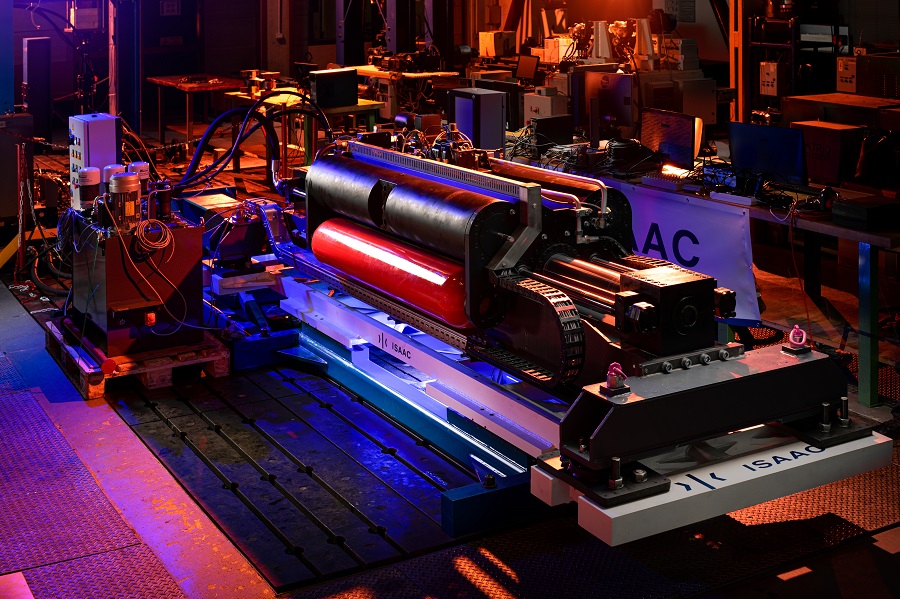
The standard in seismic engineering today is to numerically analyze and simulate with calculation software the seismic improvement brought to a building by interventions aimed at modifying its structural response (reinforcements, isolators, dampers, …), without experimentally verifying the real effectiveness in case of an earthquake. ISAAC Antisismica, the startup that in February 2019 won the SHaReD call (launched by Fondazione Pesenti with Speed MI Up, the incubator of Bocconi University), with its experimentation decided to go further, testing the behavior of its ISAAC Protection 1 (I‑Pro 1) technology in “real conditions.”
The results
At an intensity equal to 70% of the base earthquake, the control structure without the I‑Pro 1 system showed evident damage to non-structural elements, while the structure equipped with the active control system I‑Pro 1 remained intact.
Subjected to the simulated earthquake at maximum intensity (equal to 137% of the base earthquake), the control structure showed evident damage: non-structural elements were heavily damaged, with partial collapse of the infill walls, and structural elements were compromised with the complete failure of the slab-column joints on the first floor, damages that compromise the usability of the structure, possible post-earthquake restoration, and its resistance to horizontal loads. The structure protected by I‑Pro 1 only experienced minor cracks on non-structural elements (plaster).

VIDEO
isaacantisismica.com

Comunicato Stampa