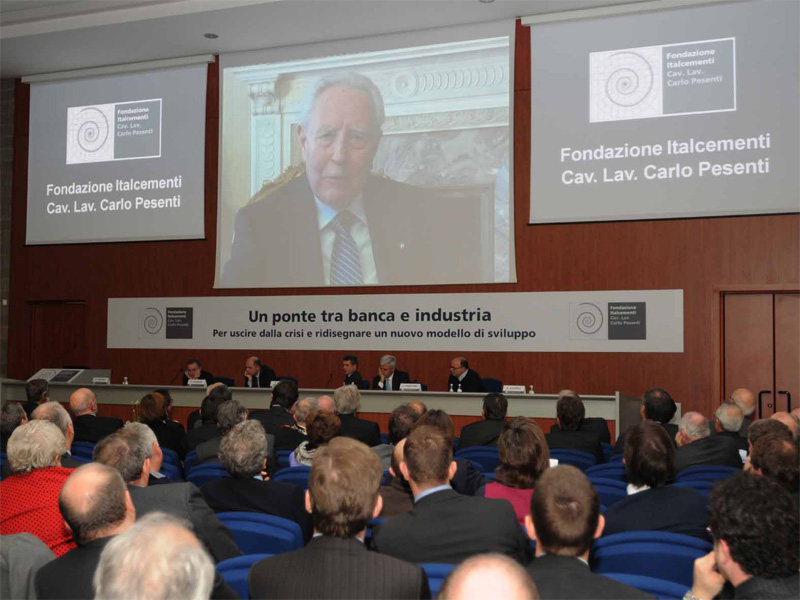
The strategic rethinking of the relationship between the credit sector and industry, following the systemic crisis that caused the recent economic and financial shock, is a concrete way to support the “exit strategy” and offer prospects for the recovery of the real economy. All this without losing sight of the ethical perception and fundamental values of “sustainability” that characterize a proper economic development process.
Bergamo, December 12, 2009 – “A bridge between banking and industry. To exit the crisis and redesign a new development model.” This was the message of the sixth conference organized by the Cav. Lav. Carlo Pesenti held in Bergamo, which has become an important event for discussion on key economic and industrial topics. In previous years, it has featured Nobel laureates such as Joseph Stiglitz and Michael Spence, as well as economists and academics including Alberto Alesina, Taotao Chen, Domenico Siniscalco, and Tito Boeri.
After the opening greeting from the Foundation’s president, Giovanni Giavazzi, the event brought together key players from the Italian credit and industrial sectors to directly confront the scenario of the first signs of a “post-crisis,” outlined in an analysis by Mario Deaglio.
A new “bridge” for the country’s development
 Corrado Passera, CEO of Intesa Sanpaolo, and Alessandro Profumo, CEO of Unicredit, on one side; Andrea Guerra, CEO of Luxottica, and Giorgio Squinzi, sole director of Mapei and president of Federchimica, on the other. They discussed the need for a new “bridge” and new rules for the country’s development, supported by Giorgio Barba Navaretti, Professor of Political Economy at the University of Milan, who coordinated the debate.
Despite the initial signs of economic improvement, the persistent weakness of demand and its long-term implications—such as rising unemployment and declining investments—pose a very difficult challenge to banks and companies, necessitating a review not only of market rules and controls but also of the constraints and objectives underpinning their operational relations.
The issue of rules and supervision of market mechanisms—recently addressed by the EU—and especially the need for a shared hierarchy of values was strongly emphasized by the contribution of the President Emeritus of the Republic, Carlo Azeglio Ciampi.
Carlo Azeglio Ciampi
“Over the last twenty years, we have witnessed the progressive expansion of global finance, becoming completely detached from the needs of the real economy. With a paradigm shift, finance has gone from servant to master,” Ciampi emphasized in a video message for the Foundation’s conference. “Efforts to write new rules for finance continue with commitment, despite the difficulty of reconciling sometimes conflicting interests.
We are confident that results will come soon. But,” he added, “strict rules and coordinated supervision will achieve little if the idea does not take hold—both individually and collectively—that a radical change is necessary in how we understand and relate to finance and the economy; especially if the hierarchy of values in which they are placed is not revised.”
At the close of the conference, Giampiero Pesenti, president of Italcementi, thanked the participants and stressed the need for continuous moral as well as entrepreneurial vigilance to recognize, even in difficult times like the present, signals that can bring about scenarios of positive change: “Times of serious crisis are also times of great opportunity.”
Opening speech by Mario Deaglio: A Lesson for the Future from the Crisis
Press review – News agencies
Press review – Local Newspapers
Press review – National Newspapers
Gallery
[oqeygallery id=”11″]