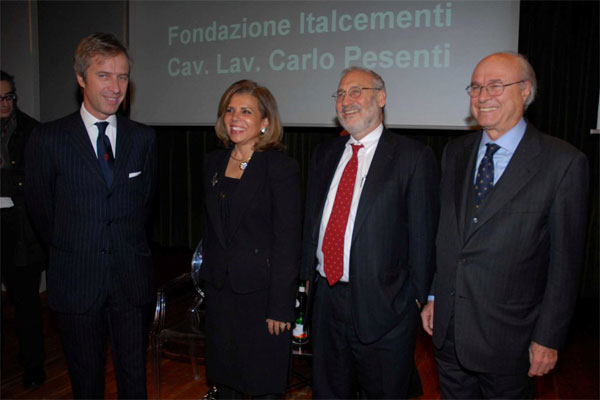
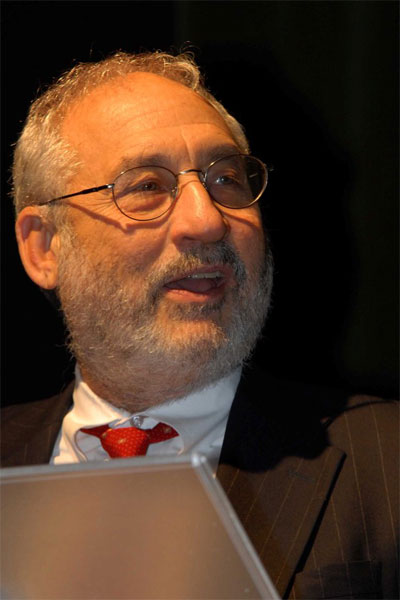
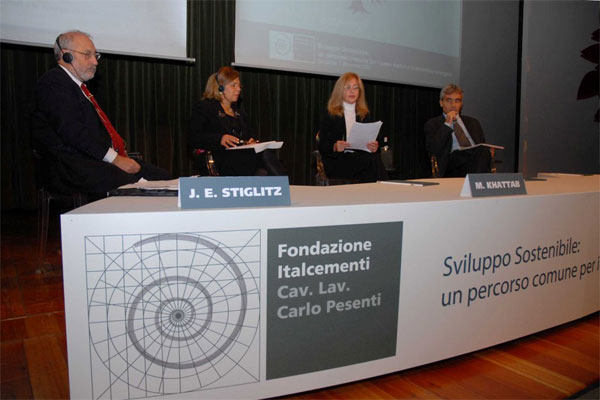
The Nobel Laureate J. Stiglitz at the annual conference of the Fondazione Cav. Lav. Carlo Pesenti:
“Globalization is an inevitable process.”
“Sustainable development, a common path for mature countries and emerging economies.” An imaginary bridge capable of directly connecting industrialized countries with emerging ones, aiming to address global development issues on a shared road toward sustainability.
This was the central theme guiding the fourth annual conference of the Fondazione Cav. Lav. Carlo Pesenti, held at the Bergamo Congress Center and dedicated this year to Sustainable Development: a common path for mature countries and emerging economies.
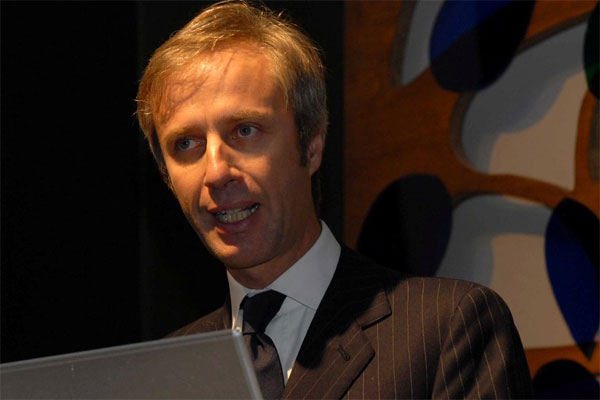
After the opening remarks by the Fondazione President, Giovanni Giavazzi, over four hundred guests attending the event followed the speech of the Nobel Prize-winning economist Joseph E. Stiglitz, who with his project “Initiative for Policy Dialogue” analyzed the mistakes and benefits of globalization, aiming to show emerging countries all possible economic policy alternatives and promote broad and informed participation of civil society in decision-making.
Joseph E. Stiglitz: globalization, an inevitable process
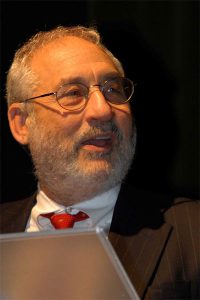 A thorough examination, developed in the following years through studies — rewarded with the Nobel Prize in 2001 — on informational asymmetries and their impact on market functioning; which led Stiglitz to affirm that globalization is an inevitable process. It is possible to steer it toward the welfare of less developed countries and citizens of advanced countries through a mix of solidarity policies and intervention by international institutions.
 According to Stiglitz, economic globalization is a positive force, capable of encouraging growth and improving the living conditions of the poorest populations on the planet. Therefore, a reconsideration of trade agreements, economic policies imposed on developing countries, international aid, and the global financial system is necessary.
The reforms
These and other reforms would allow globalization to develop all its potential, respecting democracy and social justice. During the event, video contributions were shown from Al Gore, 2007 Nobel Peace Prize laureate; TaoTao Chen, professor at the Center for China – Tsinghua University, Beijing; Barack Obama, Democratic Senator and 2008 US Presidential candidate; and Suketu Mehta, writer and journalist, finalist for the 2005 Pulitzer Prize.
In particular, Al Gore in his message emphasized the environmental aspect: “We are facing a planetary emergency, an emergency threatening the future of civilization and humanity.
Members of the global business community, governments, and civil society all bear responsibility regarding the climate crisis. Some initiatives have begun: Italy, in particular, ranks seventh worldwide in installed wind capacity and has doubled its total renewable resources since 1990.
Therefore, this path must continue, accelerating the pace, but it is a journey possible only through a closer partnership between government and industry.”
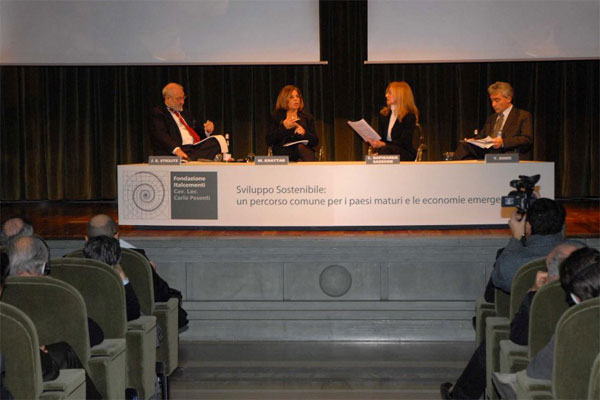
Roundtable
The Fondazione’s conference concluded with a round table including, besides Stiglitz: Tito Boeri, Professor of Economics at Bocconi University, and Moushira Khattab, Secretary General of the National Council for Childhood and Motherhood in Egypt and Vice President of the United Nations Committee on the Rights of the Child.
Carlo Pesenti highlighted during the conference conclusions the consistency of the Group’s policies with the principles of sustainability. “For us, this choice meant creating an industrial group capable of expressing a modern and innovative mindset; and the great ability of the various entities in the Group to work together to win together in the competition of the local market.
Our willingness to change,” he added, “has pushed us to anchor our industrial development policy to founding principles capable of implementing that integration between global dimension and local reality; at the core of our corporate identity.”
Giampiero Pesenti, thanking the speakers at the conference, recalled the connection between Professor Stiglitz and the University of Bergamo, which awarded him an Honorary Degree. “It is a positive sign of the convergence of extraordinary qualities: the thought of the authoritative economist, his intellectual vitality and generosity, and the spirit of initiative and modernity of our territory.”
Press Release
Al Gore
Barack Obama
Joseph Stiglitz
Moushira Khattab
Suketu Mehta
Taotao Chen
Tito Boeri
Giovanni Giavazzi
Giampiero Pesenti
Carlo Pesenti
Cristina Sassoon
Gallery