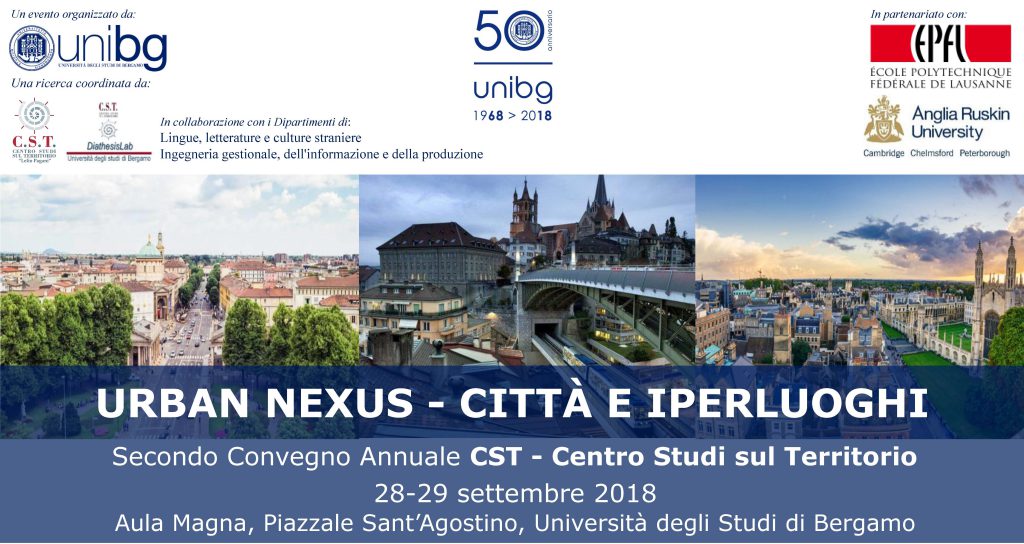
On September 28-29, 2018, the conference Urban Nexus – Cities and Hyperplaces will take place.
It is coordinated by Emanuela Casti, Director of the Center for Territorial Studies at the University of Bergamo (CST), head of DiathesisLab and creator/coordinator of the RIFO initiative supported by Fondazione Pesenti.
The conference presents the results of the Urban Nexus research, funded by the University of Bergamo within the Excellence initiative Program and coordinated by the Center for Territorial Studies in collaboration with the Departments of Languages, Literatures and Foreign Cultures and of Management, Information and Production Engineering. This research promoted a partnership with two foreign universities, EPFL (École Polytechnique Fédérale de Lausanne) and Anglia Ruskin University of Cambridge, and was supported by ISTAT of Rome (working group on smart cities and Big Data) and CNR-IREA of Milan.
Starting from the dynamism of the “city” in the Era of globalization and its polycentric and networked configuration, the research investigated the use of Big Data in socio-territorial analyses and experimented with new algorithms able to process and visually communicate the complexity of information.
Following the paradigm of data-driven science, which integrates the knowledge of computer and computational sciences with that of territorial sciences, interpretations and analyses were produced alongside those obtained through data collected from public institutions, with the aim of tracing the dynamism of inhabitants and outlining the polarity of urban nodes.
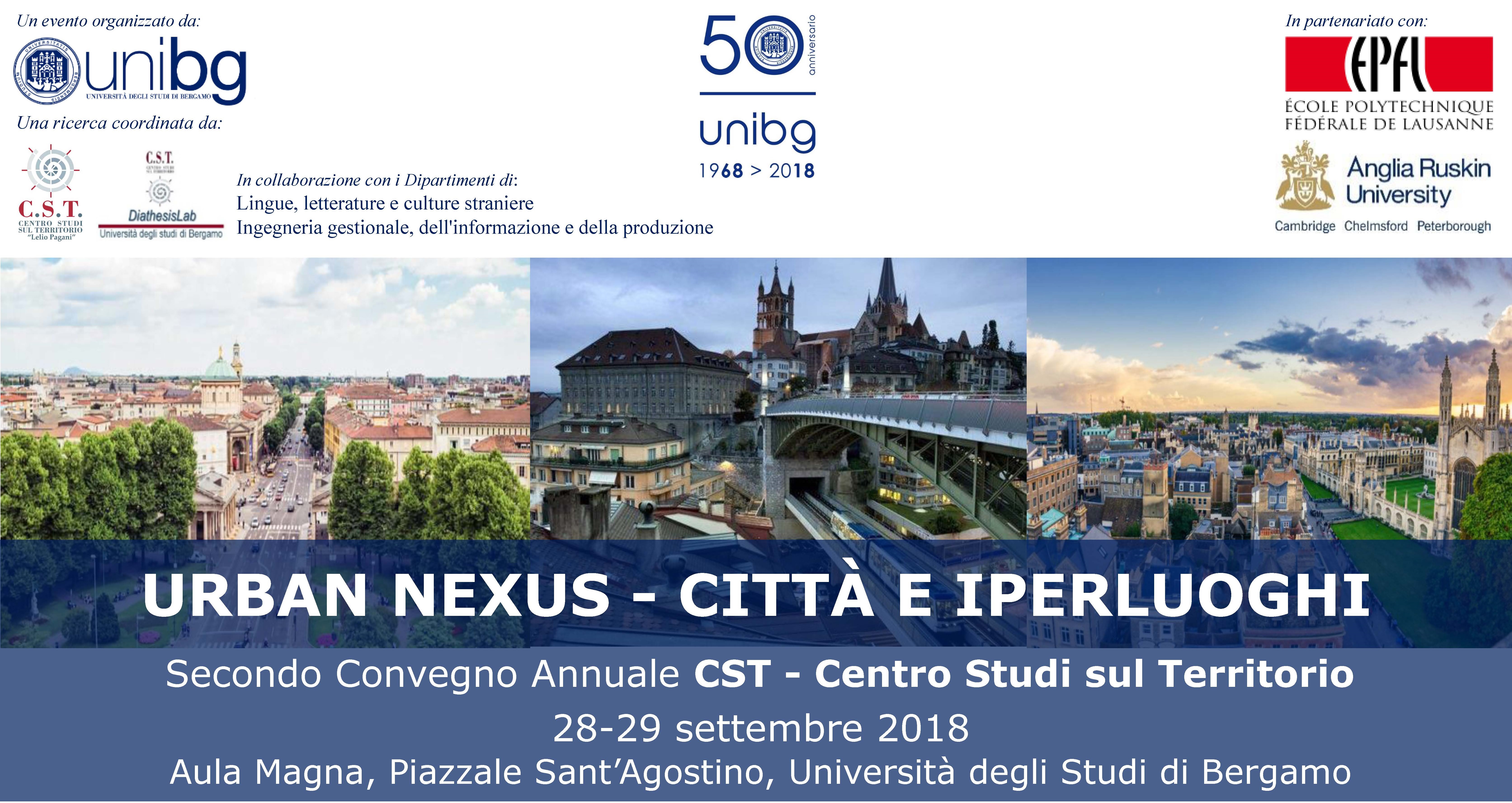
The investigation concerned new forms of public space – the so-called “hyperplaces” such as shopping centers, airports, stations, amusement parks, cultural places – and urban mobility which are reconfiguring even medium-sized cities such as Bergamo, Lausanne, Cambridge.
From the beginning, both the complexity and the potential of a multidisciplinary group to devise methodologies and hybrid analysis paths were evident, capable of merging the interpretative skills of geographers and territorial analysts with those of computational systems engineers in an interdisciplinary approach.
The conference submits to international experts the results achieved by the research and the analytical pathways traced by the network of researchers, offering public and private actors of the territory a platform of ideas and reflections in the spirit of technology transfer, to which the University of Bergamo responds as a Third Mission action.
Diathesis Lab

www.unibg.it

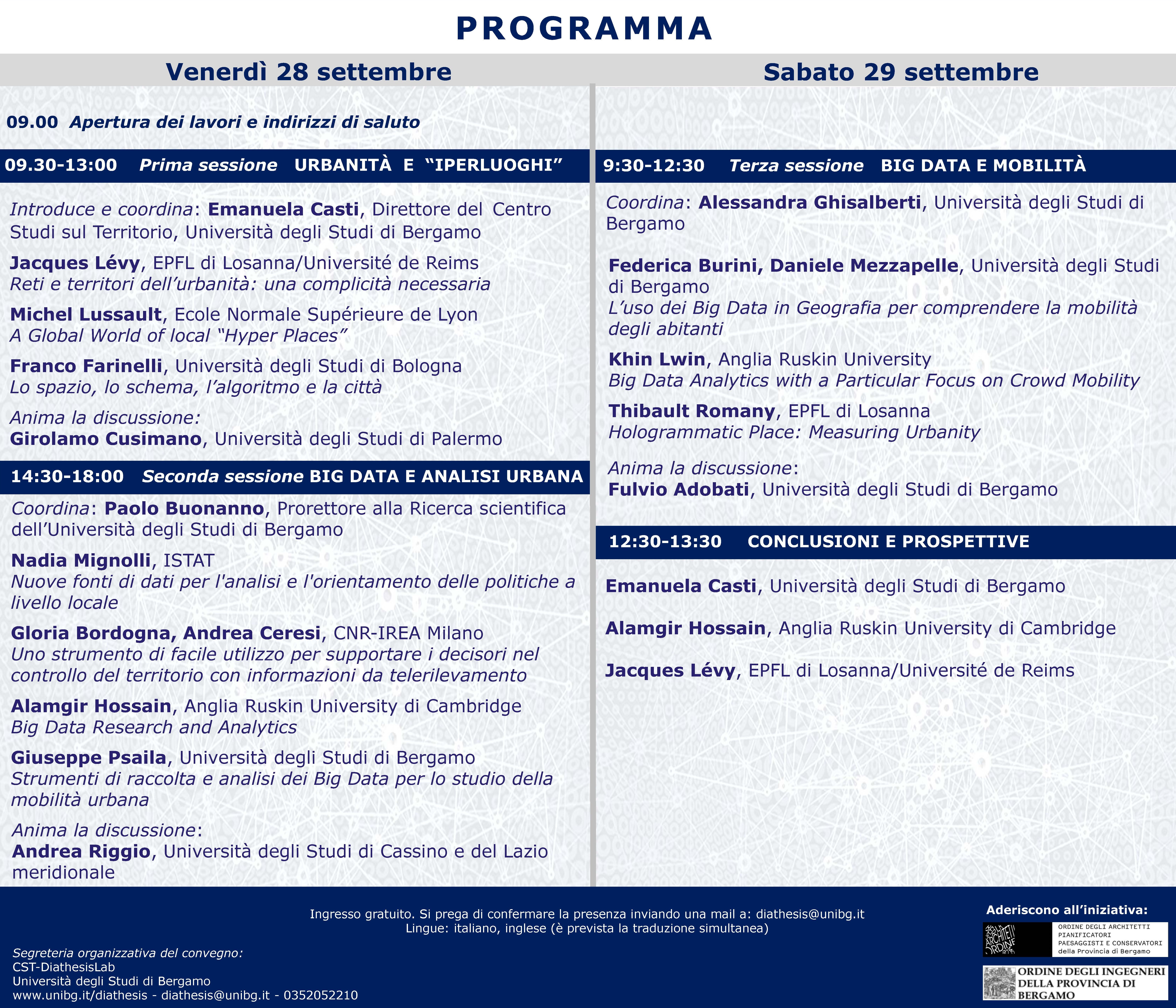
Programma